

Pedagogical AI built to protect students' critical thinking
While other AI hands students the answers, PROCLUS gives feedback that makes them do their own writing and thinking.
WHY?

Every student has access to AI, and many use it to produce their work instead of doing the thinking themselves. It's quietly eroding their ability to write and think critically, and schools have no way to mitigate that risk. That's exactly what PROCLUS does. It's a pedagogical AI that never gives students the answer, it gives feedback that makes them do their own writing and thinking, and it shows teachers exactly how each piece of work was developed.
Every school whose students have access to AI is going to need it.
PROCLUS – Changes everything
Made by AI-magician Joseph Langdon at MovingPixels.no
The safety layer your school needs to embrace AI
PROCLUS isn’t another tool competing for the classroom; it’s the infrastructure that makes AI safe for your teachers to allow.
Most AI tools for schools create a conflict: they offer efficiency but erode the very thinking you are trying to cultivate. We built PROCLUS to solve this. It is the world’s first pedagogical AI that protects cognitive development by design.
By replacing answers with questions and feedback, PROCLUS ensures your students do their own writing and thinking. For teachers, it provides a transparent trail of the entire drafting process, making authorship verifiable. Stop banning AI and start using the pedagogical layer that keeps your standards, and your students’ thinking - intact.

“I think it was good that we got help from AI. It responded well, and was strict with the feedback. It responded in detail and said what was good and what was bad. It also said what was wrong in science, but it also said what you did wrong in grammar. What it could have done better was to explain why what I wrote was wrong and not just that it was wrong. But all in all, it was fun and helpful to use AI.”
Why use PROCLUS?
Built on the bedrock of Academic Research
Unlike generic AI tools, PROCLUS was forged in the research labs. Our platform is not just software — it is a peer-reviewed methodology translated into code
Research-proven results in real classroom trials
GDPR compliant, AI-ACT (limited risk)
WCAG/WAD compliant
FERPA compliance
COPPA some compliance

“I thought PROCLUS was a really good way to work, as everyone could get feedback without the teacher having to help everyone. It was also cool to see how KI responded to my updated text.”
Teacher has full control over assessment criteria
Traditionally the deliverable have been the evidence of the students knowledge, when a students deliverable can be produced by a prompt, we need to rethink.
In PROCLUS we shift focus to the writing process, and we provide adapted and individualised feedback to the students.
As a teacher you have full insight into the development of the students work, their feedback, and how the feedback is embedded into the text. However, it is still the teachers responsibility to grade and give final feedback to the student. PROCLUS is only helping the students in their writing process.
Curious on how it works?
AI Hallucination
PROCLUS minimized the risk of hallucination through a controlled 4-step process that ensures the AI status strictly to the facts:
Teacher’s Assignment
Clear title and explanation of the learning objectives defined by the teacherAssessment Criteria (AI Prompt)
Specific criteria that act as a constrained and focused AI promptLearner’s input
The student’s own text serving as the sole foundation for the analysisAI Feedback & Literacy
Student use their context to critically evaluate the feedback, building AI literacy
AI Bias and Fairness
While humans possess natural biases, PROCLUS AI reviews every student’s work with the same rigorous quality and methodology every single time. This ensures a level of consistency and objectivity in feedback that is strictly based on the assignment text and defined criteria.
Our work is build on a solid research foundation from the AI4AfL and ENACT projects, with specific tuning for the educational context to minimise cultural and linguistic bias.
Results from the ENACT project ensures that PROCLUS is safe and ethical to use in an educational context.
Critical Thinking as a Competency
The student knows their own context best. If AI feedback feels irrelevant or skewed, students are encouraged to evaluate it critically. This active evaluation of the AI’s “perspective” is a key part of building the student’s learning critical competence and a deep understanding of the technology’s strengths and limitations.
Putting the Teacher first.
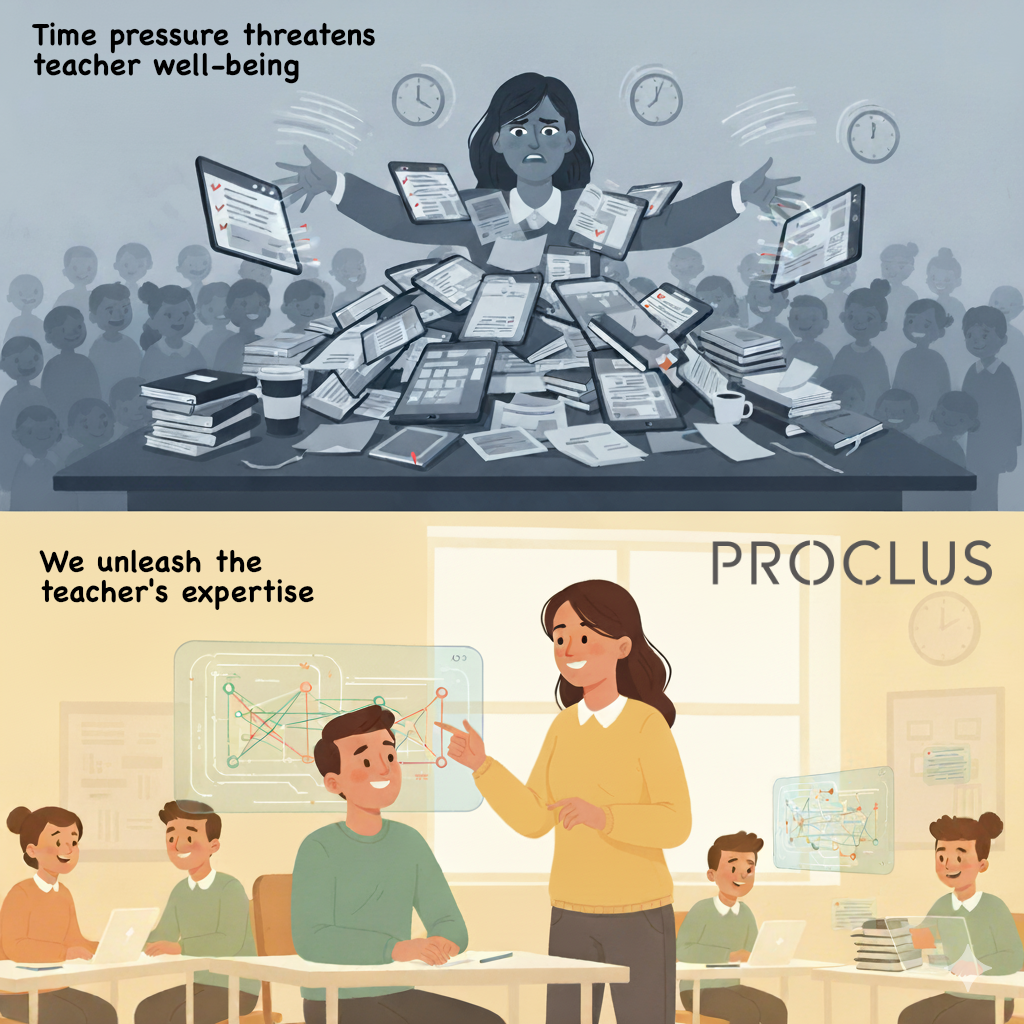
PROCLUS is designed with a fundamental philosophy: AI should support, not replace. We don’t evaluate the final deliverable, but help students through the cognitive load of writing by scaffolding the writing process, always under the teacher’s full control.
SSO - FEIDE

Why the name Proclus
