
Two students answer the same assignment. One writes three short sentences. The other hands in a well-worked page. Both deserve good feedback – but not the same feedback.
PROCLUS now adapts its feedback to the level of each student's text. Every student gets a next step within reach. And you, as a teacher, can see how each student develops through the writing process.
First, we read the text
Before PROCLUS gives feedback against your criteria, it makes a separate assessment of the student's text. It looks at many aspects at once: whether the assignment is answered, content, structure, coherence, vocabulary, grammar, sentence construction, spelling, fluency and readability. When the assignment calls for it, it also looks at argumentation.
No single thing decides. A text with many spelling mistakes can have good ideas. A text with advanced words can lack coherence. We look for patterns, not single errors. Whether the assignment is answered counts most. Spelling counts less. And we always consider what the assignment asks for – a story shouldn't be judged like an argumentative essay.
The result is a score between 1 and 4. The score describes the text, not the student. The same student can write at different levels depending on topic, assignment and preparation. That's why we never put a fixed label on anyone.
Then we adapt the feedback
The score is added to the instructions you've set for the assignment. Your criteria always apply. What changes is what the feedback prioritises – and how much the student gets at once.
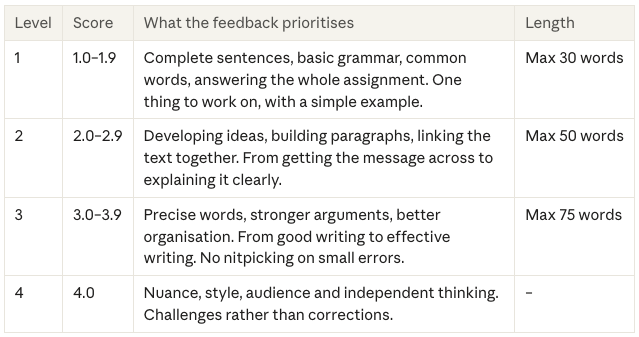
You can see the difference. A student at level 1 might get: "Your main idea is clear. Look at sentences 2 and 4. Can you find what's missing?" A student at level 4 might get: "Is there another perspective you could consider?"
Whatever the level, one thing holds: PROCLUS never gives answers or finished text. Students get feedback and questions – and do the thinking themselves. The goal is for every student to know where their text stands, what works, and what the next step is.
New for teachers: see the progress
You can now see the assessment score in all 11 categories for every student in your class, along with two short lists: what the text does well, and what the student should work on next. You can also see how the score has developed through the writing process – from draft to draft, as the student takes up the feedback.
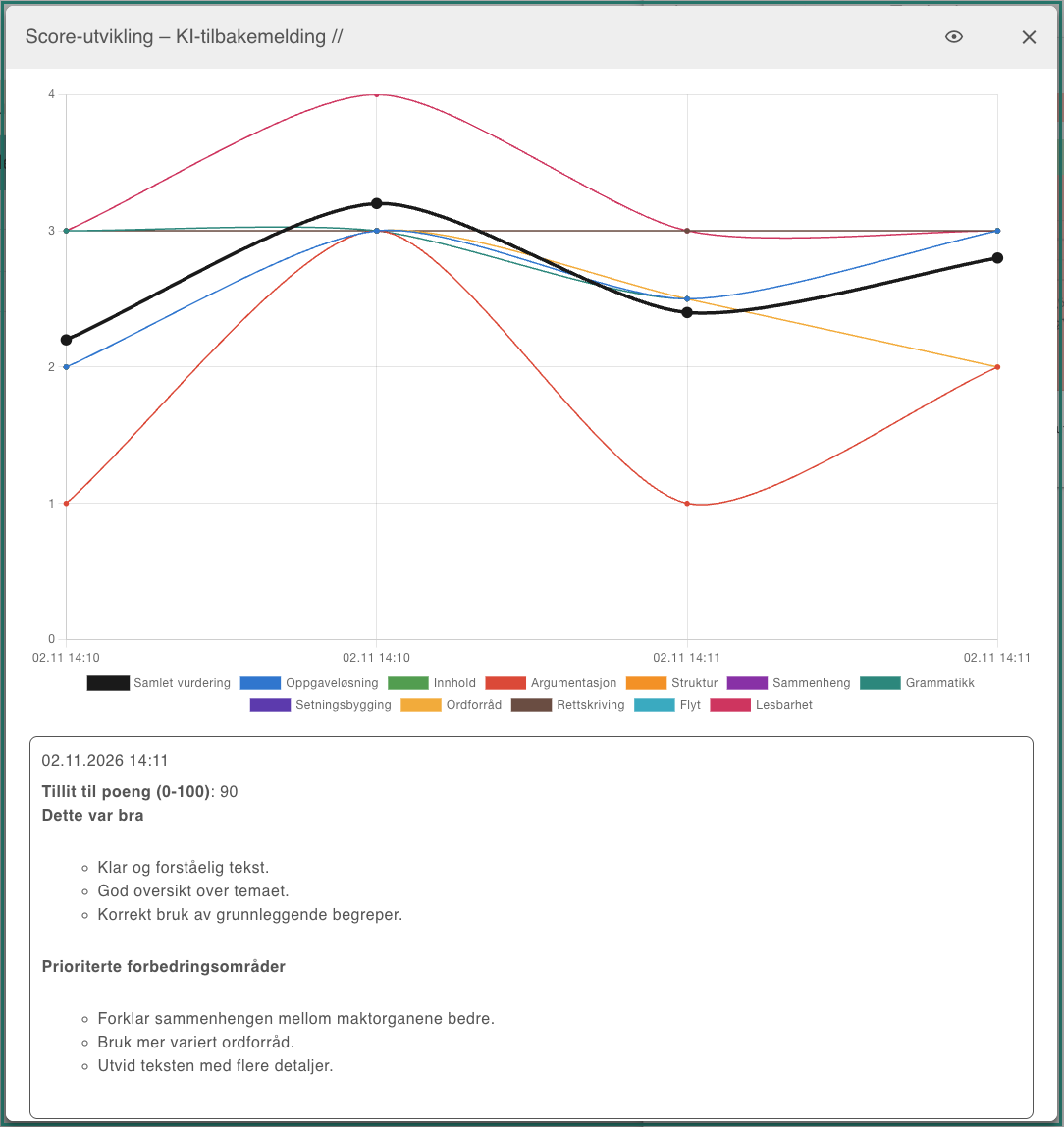
That gives you:
An overview: who needs what, without rereading every draft.
An answer to whether the feedback works: you can see if the student actually moves where it matters.
A starting point for conversation: concrete areas to talk through with the student.
The score is a signal, not a grade. You make the final assessment and give the final feedback.
Students never see the score
Scores and results are never shared with the student. The student only gets the feedback.
That's a deliberate choice. A number can quickly become a label – "I'm a two." We want students to look at their text, not at a number. The score is a tool for making the feedback land, and insight for you as a teacher.
